

添加短期记忆
短期记忆(线程级别持久化)使智能体能够跟踪多轮对话。要添加短期记忆:import { MemorySaver, StateGraph } from "@langchain/langgraph";
const checkpointer = new MemorySaver();
const builder = new StateGraph(...);
const graph = builder.compile({ checkpointer });
await graph.invoke(
{ messages: [{ role: "user", content: "hi! i am Bob" }] },
{ configurable: { thread_id: "1" } }
);
在生产中使用
在生产环境中,使用由数据库支持的检查点器:import { PostgresSaver } from "@langchain/langgraph-checkpoint-postgres";
const DB_URI = "postgresql://postgres:postgres@localhost:5442/postgres?sslmode=disable";
const checkpointer = PostgresSaver.fromConnString(DB_URI);
const builder = new StateGraph(...);
const graph = builder.compile({ checkpointer });
Example: using Postgres checkpointer
Example: using Postgres checkpointer
npm install @langchain/langgraph-checkpoint-postgres
您在使用Postgres检查点器第一次时需要调用
checkpointer.setup()import { ChatAnthropic } from "@langchain/anthropic";
import { StateGraph, MessagesZodMeta, START } from "@langchain/langgraph";
import { BaseMessage } from "@langchain/core/messages";
import { registry } from "@langchain/langgraph/zod";
import * as z from "zod";
import { PostgresSaver } from "@langchain/langgraph-checkpoint-postgres";
const MessagesZodState = z.object({
messages: z
.array(z.custom<BaseMessage>())
.register(registry, MessagesZodMeta),
});
const model = new ChatAnthropic({ model: "claude-3-5-haiku-20241022" });
const DB_URI = "postgresql://postgres:postgres@localhost:5442/postgres?sslmode=disable";
const checkpointer = PostgresSaver.fromConnString(DB_URI);
// await checkpointer.setup();
const builder = new StateGraph(MessagesZodState)
.addNode("call_model", async (state) => {
const response = await model.invoke(state.messages);
return { messages: [response] };
})
.addEdge(START, "call_model");
const graph = builder.compile({ checkpointer });
const config = {
configurable: {
thread_id: "1"
}
};
for await (const chunk of await graph.stream(
{ messages: [{ role: "user", content: "hi! I'm bob" }] },
{ ...config, streamMode: "values" }
)) {
console.log(chunk.messages.at(-1)?.content);
}
for await (const chunk of await graph.stream(
{ messages: [{ role: "user", content: "what's my name?" }] },
{ ...config, streamMode: "values" }
)) {
console.log(chunk.messages.at(-1)?.content);
}
在子图中使用
如果您的图包含子图,您只需要在编译父图时提供检查点器。LangGraph会自动将检查点器传播到子子图中。import { StateGraph, START, MemorySaver } from "@langchain/langgraph";
import * as z from "zod";
const State = z.object({ foo: z.string() });
const subgraphBuilder = new StateGraph(State)
.addNode("subgraph_node_1", (state) => {
return { foo: state.foo + "bar" };
})
.addEdge(START, "subgraph_node_1");
const subgraph = subgraphBuilder.compile();
const builder = new StateGraph(State)
.addNode("node_1", subgraph)
.addEdge(START, "node_1");
const checkpointer = new MemorySaver();
const graph = builder.compile({ checkpointer });
const subgraphBuilder = new StateGraph(...);
const subgraph = subgraphBuilder.compile({ checkpointer: true });
添加长期记忆
使用长期记忆来存储跨对话的用户特定或应用特定数据。import { InMemoryStore, StateGraph } from "@langchain/langgraph";
const store = new InMemoryStore();
const builder = new StateGraph(...);
const graph = builder.compile({ store });
在生产中使用
在生产环境中,使用由数据库支持的存储。import { PostgresStore } from "@langchain/langgraph-checkpoint-postgres/store";
const DB_URI = "postgresql://postgres:postgres@localhost:5442/postgres?sslmode=disable";
const store = PostgresStore.fromConnString(DB_URI);
const builder = new StateGraph(...);
const graph = builder.compile({ store });
Example: using Postgres store
Example: using Postgres store
npm install @langchain/langgraph-checkpoint-postgres
您在使用Postgres存储时需要首次调用
store.setup()import { ChatAnthropic } from "@langchain/anthropic";
import { StateGraph, MessagesZodMeta, START, LangGraphRunnableConfig } from "@langchain/langgraph";
import { PostgresSaver } from "@langchain/langgraph-checkpoint-postgres";
import { PostgresStore } from "@langchain/langgraph-checkpoint-postgres/store";
import { BaseMessage } from "@langchain/core/messages";
import { registry } from "@langchain/langgraph/zod";
import * as z from "zod";
import { v4 as uuidv4 } from "uuid";
const MessagesZodState = z.object({
messages: z
.array(z.custom<BaseMessage>())
.register(registry, MessagesZodMeta),
});
const model = new ChatAnthropic({ model: "claude-3-5-haiku-20241022" });
const DB_URI = "postgresql://postgres:postgres@localhost:5442/postgres?sslmode=disable";
const store = PostgresStore.fromConnString(DB_URI);
const checkpointer = PostgresSaver.fromConnString(DB_URI);
// await store.setup();
// await checkpointer.setup();
const callModel = async (
state: z.infer<typeof MessagesZodState>,
config: LangGraphRunnableConfig,
) => {
const userId = config.configurable?.userId;
const namespace = ["memories", userId];
const memories = await config.store?.search(namespace, { query: state.messages.at(-1)?.content });
const info = memories?.map(d => d.value.data).join("\n") || "";
const systemMsg = `You are a helpful assistant talking to the user. User info: ${info}`;
// Store new memories if the user asks the model to remember
const lastMessage = state.messages.at(-1);
if (lastMessage?.content?.toLowerCase().includes("remember")) {
const memory = "User name is Bob";
await config.store?.put(namespace, uuidv4(), { data: memory });
}
const response = await model.invoke([
{ role: "system", content: systemMsg },
...state.messages
]);
return { messages: [response] };
};
const builder = new StateGraph(MessagesZodState)
.addNode("call_model", callModel)
.addEdge(START, "call_model");
const graph = builder.compile({
checkpointer,
store,
});
const config = {
configurable: {
thread_id: "1",
userId: "1",
}
};
for await (const chunk of await graph.stream(
{ messages: [{ role: "user", content: "Hi! Remember: my name is Bob" }] },
{ ...config, streamMode: "values" }
)) {
console.log(chunk.messages.at(-1)?.content);
}
const config2 = {
configurable: {
thread_id: "2",
userId: "1",
}
};
for await (const chunk of await graph.stream(
{ messages: [{ role: "user", content: "what is my name?" }] },
{ ...config2, streamMode: "values" }
)) {
console.log(chunk.messages.at(-1)?.content);
}
使用语义搜索
启用您图内存存储中的语义搜索功能,以便图智能体可以通过语义相似度在存储中搜索项目。import { OpenAIEmbeddings } from "@langchain/openai";
import { InMemoryStore } from "@langchain/langgraph";
// Create store with semantic search enabled
const embeddings = new OpenAIEmbeddings({ model: "text-embedding-3-small" });
const store = new InMemoryStore({
index: {
embeddings,
dims: 1536,
},
});
await store.put(["user_123", "memories"], "1", { text: "I love pizza" });
await store.put(["user_123", "memories"], "2", { text: "I am a plumber" });
const items = await store.search(["user_123", "memories"], {
query: "I'm hungry",
limit: 1,
});
Long-term memory with semantic search
Long-term memory with semantic search
import { OpenAIEmbeddings, ChatOpenAI } from "@langchain/openai";
import { StateGraph, START, MessagesZodMeta, InMemoryStore } from "@langchain/langgraph";
import { BaseMessage } from "@langchain/core/messages";
import { registry } from "@langchain/langgraph/zod";
import * as z from "zod";

const MessagesZodState = z.object({
    messages: z
    .array(z.custom<BaseMessage>())
    .register(registry, MessagesZodMeta),
});

const model = new ChatOpenAI({ model: "gpt-4o-mini" });

// Create store with semantic search enabled
const embeddings = new OpenAIEmbeddings({ model: "text-embedding-3-small" });
const store = new InMemoryStore({
    index: {
    embeddings,
    dims: 1536,
    }
});

await store.put(["user_123", "memories"], "1", { text: "I love pizza" });
await store.put(["user_123", "memories"], "2", { text: "I am a plumber" });

const chat = async (state: z.infer<typeof MessagesZodState>, config) => {
    // Search based on user's last message
    const items = await config.store.search(
    ["user_123", "memories"],
    { query: state.messages.at(-1)?.content, limit: 2 }
    );
    const memories = items.map(item => item.value.text).join("\n");
    const memoriesText = memories ? `## Memories of user\n${memories}` : "";

    const response = await model.invoke([
    { role: "system", content: `You are a helpful assistant.\n${memoriesText}` },
    ...state.messages,
    ]);

    return { messages: [response] };
};

const builder = new StateGraph(MessagesZodState)
    .addNode("chat", chat)
    .addEdge(START, "chat");
const graph = builder.compile({ store });

for await (const [message, metadata] of await graph.stream(
    { messages: [{ role: "user", content: "I'm hungry" }] },
    { streamMode: "messages" }
)) {
    if (message.content) {
    console.log(message.content);
    }
}
管理短期记忆
启用短期记忆后,长对话可能会超出LLM的上下文窗口。常见解决方案包括:- 裁剪消息: 在调用LLM之前移除前N条或最后N条消息
- 删除消息 从LangGraph状态中永久删除
- 总结消息: 总结历史中的早期消息并用总结替换它们
- 管理检查点 以存储和检索消息历史
- 自定义策略(例如,消息过滤等)
去除消息
大多数大型语言模型(LLM)都有一个最大支持的上下文窗口(以令牌计)。决定何时截断消息的一种方法是通过计算消息历史中的令牌数量,并在接近该限制时进行截断。如果您使用LangChain,可以使用trim messages实用程序,并指定从列表中保留的令牌数量,以及用于处理边界的strategy(例如,保留最后的 maxTokens)。
要修剪消息历史,请使用trimMessages函数:
import { trimMessages } from "@langchain/core/messages";

const callModel = async (state: z.infer<typeof MessagesZodState>) => {
  const messages = trimMessages(state.messages, {
    strategy: "last",
    maxTokens: 128,
    startOn: "human",
    endOn: ["human", "tool"],
  });
  const response = await model.invoke(messages);
  return { messages: [response] };
};

const builder = new StateGraph(MessagesZodState)
  .addNode("call_model", callModel);
// ...
Full example: trim messages
Full example: trim messages
import { trimMessages, BaseMessage } from "@langchain/core/messages";
import { ChatAnthropic } from "@langchain/anthropic";
import { StateGraph, START, MessagesZodMeta, MemorySaver } from "@langchain/langgraph";
import { registry } from "@langchain/langgraph/zod";
import * as z from "zod";

const MessagesZodState = z.object({
  messages: z
    .array(z.custom<BaseMessage>())
    .register(registry, MessagesZodMeta),
});

const model = new ChatAnthropic({ model: "claude-3-5-sonnet-20241022" });

const callModel = async (state: z.infer<typeof MessagesZodState>) => {
  const messages = trimMessages(state.messages, {
    strategy: "last",
    maxTokens: 128,
    startOn: "human",
    endOn: ["human", "tool"],
    tokenCounter: model,
  });
  const response = await model.invoke(messages);
  return { messages: [response] };
};

const checkpointer = new MemorySaver();
const builder = new StateGraph(MessagesZodState)
  .addNode("call_model", callModel)
  .addEdge(START, "call_model");
const graph = builder.compile({ checkpointer });

const config = { configurable: { thread_id: "1" } };
await graph.invoke({ messages: [{ role: "user", content: "hi, my name is bob" }] }, config);
await graph.invoke({ messages: [{ role: "user", content: "write a short poem about cats" }] }, config);
await graph.invoke({ messages: [{ role: "user", content: "now do the same but for dogs" }] }, config);
const finalResponse = await graph.invoke({ messages: [{ role: "user", content: "what's my name?" }] }, config);

console.log(finalResponse.messages.at(-1)?.content);
Your name is Bob, as you mentioned when you first introduced yourself.
删除消息
您可以删除图状态中的消息以管理消息历史。这在您想要删除特定消息或清除整个消息历史时非常有用。 要删除图状态中的消息,您可以使用RemoveMessage。为了使 RemoveMessage 正常工作,您需要使用具有 messagesStateReducer reducer 的状态键,例如 MessagesZodState。
为了删除特定消息:
import { RemoveMessage } from "@langchain/core/messages";

const deleteMessages = (state) => {
  const messages = state.messages;
  if (messages.length > 2) {
    // remove the earliest two messages
    return {
      messages: messages
        .slice(0, 2)
        .map((m) => new RemoveMessage({ id: m.id })),
    };
  }
};
在删除消息时,请确保生成的消息历史记录是有效的。检查您所使用的LLM提供商的限制。例如:
- 一些提供商期望消息历史从一条
user消息开始 - 大多数提供商要求工具调用后的
assistant消息后面必须跟随相应的tool结果消息。
Full example: delete messages
Full example: delete messages
import { RemoveMessage, BaseMessage } from "@langchain/core/messages";
import { ChatAnthropic } from "@langchain/anthropic";
import { StateGraph, START, MemorySaver, MessagesZodMeta } from "@langchain/langgraph";
import * as z from "zod";
import { registry } from "@langchain/langgraph/zod";

const MessagesZodState = z.object({
  messages: z
    .array(z.custom<BaseMessage>())
    .register(registry, MessagesZodMeta),
});

const model = new ChatAnthropic({ model: "claude-3-5-sonnet-20241022" });

const deleteMessages = (state: z.infer<typeof MessagesZodState>) => {
  const messages = state.messages;
  if (messages.length > 2) {
    // remove the earliest two messages
    return { messages: messages.slice(0, 2).map(m => new RemoveMessage({ id: m.id })) };
  }
  return {};
};

const callModel = async (state: z.infer<typeof MessagesZodState>) => {
  const response = await model.invoke(state.messages);
  return { messages: [response] };
};

const builder = new StateGraph(MessagesZodState)
  .addNode("call_model", callModel)
  .addNode("delete_messages", deleteMessages)
  .addEdge(START, "call_model")
  .addEdge("call_model", "delete_messages");

const checkpointer = new MemorySaver();
const app = builder.compile({ checkpointer });

const config = { configurable: { thread_id: "1" } };

for await (const event of await app.stream(
  { messages: [{ role: "user", content: "hi! I'm bob" }] },
  { ...config, streamMode: "values" }
)) {
  console.log(event.messages.map(message => [message.getType(), message.content]));
}

for await (const event of await app.stream(
  { messages: [{ role: "user", content: "what's my name?" }] },
  { ...config, streamMode: "values" }
)) {
  console.log(event.messages.map(message => [message.getType(), message.content]));
}
[['human', "hi! I'm bob"]]
[['human', "hi! I'm bob"], ['ai', 'Hi Bob! How are you doing today? Is there anything I can help you with?']]
[['human', "hi! I'm bob"], ['ai', 'Hi Bob! How are you doing today? Is there anything I can help you with?'], ['human', "what's my name?"]]
[['human', "hi! I'm bob"], ['ai', 'Hi Bob! How are you doing today? Is there anything I can help you with?'], ['human', "what's my name?"], ['ai', 'Your name is Bob.']]
[['human', "what's my name?"], ['ai', 'Your name is Bob.']]
消息摘要
上述示例中,对消息进行裁剪或删除的问题在于,你可能会从消息队列的筛选中丢失信息。正因为如此,一些应用程序从使用聊天模型对消息历史进行更复杂的总结方法中获益。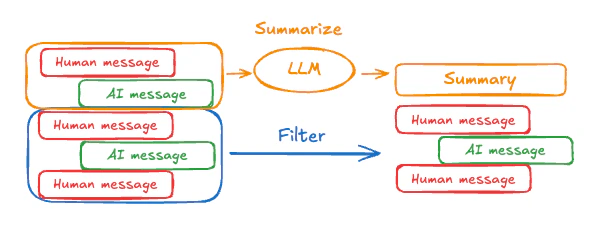
summary 键,与 messages 键一起:
import { BaseMessage } from "@langchain/core/messages";
import { MessagesZodMeta } from "@langchain/langgraph";
import { registry } from "@langchain/langgraph/zod";
import * as z from "zod";

const State = z.object({
  messages: z
    .array(z.custom<BaseMessage>())
    .register(registry, MessagesZodMeta),
  summary: z.string().optional(),
});
summarizeConversation 节点可以在积累了一定数量的消息后,在 messages 状态键中调用。
import { RemoveMessage, HumanMessage } from "@langchain/core/messages";

const summarizeConversation = async (state: z.infer<typeof State>) => {
  // First, we get any existing summary
  const summary = state.summary || "";

  // Create our summarization prompt
  let summaryMessage: string;
  if (summary) {
    // A summary already exists
    summaryMessage =
      `This is a summary of the conversation to date: ${summary}\n\n` +
      "Extend the summary by taking into account the new messages above:";
  } else {
    summaryMessage = "Create a summary of the conversation above:";
  }

  // Add prompt to our history
  const messages = [
    ...state.messages,
    new HumanMessage({ content: summaryMessage })
  ];
  const response = await model.invoke(messages);

  // Delete all but the 2 most recent messages
  const deleteMessages = state.messages
    .slice(0, -2)
    .map(m => new RemoveMessage({ id: m.id }));

  return {
    summary: response.content,
    messages: deleteMessages
  };
};
Full example: summarize messages
Full example: summarize messages
import { ChatAnthropic } from "@langchain/anthropic";
import {
  SystemMessage,
  HumanMessage,
  RemoveMessage,
  type BaseMessage
} from "@langchain/core/messages";
import {
  MessagesZodMeta,
  StateGraph,
  START,
  END,
  MemorySaver,
} from "@langchain/langgraph";
import { BaseMessage } from "@langchain/core/messages";
import { registry } from "@langchain/langgraph/zod";
import * as z from "zod";
import { v4 as uuidv4 } from "uuid";

const memory = new MemorySaver();

// We will add a `summary` attribute (in addition to `messages` key,
// which MessagesZodState already has)
const GraphState = z.object({
  messages: z
    .array(z.custom<BaseMessage>())
    .register(registry, MessagesZodMeta),
  summary: z.string().default(""),
});

// We will use this model for both the conversation and the summarization
const model = new ChatAnthropic({ model: "claude-3-haiku-20240307" });

// Define the logic to call the model
const callModel = async (state: z.infer<typeof GraphState>) => {
  // If a summary exists, we add this in as a system message
  const { summary } = state;
  let { messages } = state;
  if (summary) {
    const systemMessage = new SystemMessage({
      id: uuidv4(),
      content: `Summary of conversation earlier: ${summary}`,
    });
    messages = [systemMessage, ...messages];
  }
  const response = await model.invoke(messages);
  // We return an object, because this will get added to the existing state
  return { messages: [response] };
};

// We now define the logic for determining whether to end or summarize the conversation
const shouldContinue = (state: z.infer<typeof GraphState>) => {
  const messages = state.messages;
  // If there are more than six messages, then we summarize the conversation
  if (messages.length > 6) {
    return "summarize_conversation";
  }
  // Otherwise we can just end
  return END;
};

const summarizeConversation = async (state: z.infer<typeof GraphState>) => {
  // First, we summarize the conversation
  const { summary, messages } = state;
  let summaryMessage: string;
  if (summary) {
    // If a summary already exists, we use a different system prompt
    // to summarize it than if one didn't
    summaryMessage =
      `This is summary of the conversation to date: ${summary}\n\n` +
      "Extend the summary by taking into account the new messages above:";
  } else {
    summaryMessage = "Create a summary of the conversation above:";
  }

  const allMessages = [
    ...messages,
    new HumanMessage({ id: uuidv4(), content: summaryMessage }),
  ];

  const response = await model.invoke(allMessages);

  // We now need to delete messages that we no longer want to show up
  // I will delete all but the last two messages, but you can change this
  const deleteMessages = messages
    .slice(0, -2)
    .map((m) => new RemoveMessage({ id: m.id! }));

  if (typeof response.content !== "string") {
    throw new Error("Expected a string response from the model");
  }

  return { summary: response.content, messages: deleteMessages };
};

// Define a new graph
const workflow = new StateGraph(GraphState)
  // Define the conversation node and the summarize node
  .addNode("conversation", callModel)
  .addNode("summarize_conversation", summarizeConversation)
  // Set the entrypoint as conversation
  .addEdge(START, "conversation")
  // We now add a conditional edge
  .addConditionalEdges(
    // First, we define the start node. We use `conversation`.
    // This means these are the edges taken after the `conversation` node is called.
    "conversation",
    // Next, we pass in the function that will determine which node is called next.
    shouldContinue,
  )
  // We now add a normal edge from `summarize_conversation` to END.
  // This means that after `summarize_conversation` is called, we end.
  .addEdge("summarize_conversation", END);

// Finally, we compile it!
const app = workflow.compile({ checkpointer: memory });
管理检查点
您可以查看和删除检查点存储的信息。查看线程状态
const config = {
  configurable: {
    thread_id: "1",
    // optionally provide an ID for a specific checkpoint,
    // otherwise the latest checkpoint is shown
    // checkpoint_id: "1f029ca3-1f5b-6704-8004-820c16b69a5a"
  },
};
await graph.getState(config);
{
  values: { messages: [HumanMessage(...), AIMessage(...), HumanMessage(...), AIMessage(...)] },
  next: [],
  config: { configurable: { thread_id: '1', checkpoint_ns: '', checkpoint_id: '1f029ca3-1f5b-6704-8004-820c16b69a5a' } },
  metadata: {
    source: 'loop',
    writes: { call_model: { messages: AIMessage(...) } },
    step: 4,
    parents: {},
    thread_id: '1'
  },
  createdAt: '2025-05-05T16:01:24.680462+00:00',
  parentConfig: { configurable: { thread_id: '1', checkpoint_ns: '', checkpoint_id: '1f029ca3-1790-6b0a-8003-baf965b6a38f' } },
  tasks: [],
  interrupts: []
}
查看线程历史
const config = {
  configurable: {
    thread_id: "1",
  },
};

const history = [];
for await (const state of graph.getStateHistory(config)) {
  history.push(state);
}
删除线程的所有检查点
const threadId = "1";
await checkpointer.deleteThread(threadId);